About Pastor Dale

Dale O’Shields is the founding and Senior Pastor of Church of the Redeemer, a multi-cultural church that operates five campuses in Maryland, just north of the greater Washington, DC area. Pastor Dale is known for his relevant teaching style focused on practical application in people’s lives. His messages are regularly broadcast on radio and television. He is also the author of several books, devotionals and group study guides. Pastor Dale is a frequent conference speaker with a passion for leadership development and church growth. He has served as the Senior Pastor of a thriving local church for over 30 years. His heart to equip and encourage pastors and church leaders has led him to be a key founder of United Pastors Network. Pastor Dale has been involved in pastoral ministry since 1978, serving previously as Director of Campus Ministries and as an adjunct instructor at Regent University in Virginia Beach, VA. He and his wife Terry have two married daughters and seven grandchildren.

Thank You!

As a child I learned two “magic” phrases; “Please!” and “Thank you!” They’re called “magic” because of the amazing impact they have on others. When authentically used in conversations, and consistently (and sincerely) used in relationships, they become an incredible life lubricant. They make all of our interactions better.

Maybe it’s the “old school” training in me, but it seems that these words are being used less and less in our culture. Recently I mentioned to my wife how seldom I hear “thank you” after a store purchase. In fact, I can only recall one incident in the last couple of months where a business owner or retail employee actually said “thank you” after a transaction! More often than not, I’m the one saying “thank you.”

The lack of spoken appreciation is a symptom of a deeper issue — the lack of heart appreciation. What we say or fail to say is an indication of what’s present or not present in the heart. If the heart is unappreciative, self-consumed, and steeped in an attitude of entitlement, our words, or lack thereof, will reflect the same.

I regularly watch as people receive blessings, benefits, opportunities, platforms, and privileges, and then act disrespectfully or dismissively toward those who provided them. Ingratitude seems to be “trending!”

Paul, the apostle, warned about this. When writing to Timothy he commented on the increasing lack of gratitude in the world as we head toward the end of time as we know it:

But mark this: There will be terrible times in the last days. People will be lovers of themselves, lovers of money, boastful, proud, abusive, disobedient to their parents, UNGRATEFUL, unholy, without love, unforgiving, slanderous, without self-control, brutal, not lovers of the good …  – 2 Timothy 3:1-3 (NIV) (emphasis mine)

Among all the disturbing trends that come with the “last days,” Paul identified a lack of thanksgiving! As we march toward the last of the last days, one of the spreading spiritual diseases is ingratitude. It will dominate world culture.

But it doesn’t have to dominate your culture! You can guard against it. You can overcome it. You can be different! How? The three “C’s”:

  • Count your blessings.

Stop and think about all the good things in your life. Stop cataloging what you don’t have and begin counting what you do have!

  • Consider the sources.

Think about the sources of your blessings, benefits, opportunities, platforms and privileges. Who is the supplier? Who has helped you get to where you are today? Who has sacrificed and assisted you in your journey? Obviously, the primary Source is God! Put Him first on your gratitude list! Then think about all the others who have contributed to the good in your life. Move beyond the “what” of your blessings to “who” is behind your blessings!

  • Communicate your appreciation.

Thanks is not thanks until it’s given! Who do you need to say “thank you” to? Who do you need to express appreciation for? Notice the “say” and “express!” Don’t just think it, do it. Start with God! Tell Him “Thank you!” And tell some others too!

Go against the grain of the world and say “Thanks!”

Pastor Dale

Decisions

Life is filled with choices. Everyday, from start to finish, you’re choosing. It’s one of your main activities. Consciously and unconsciously, your heart and mind are constantly sorting through options, coming to conclusions, and making choices. Some decisions are simple and inconsequential–a blue shirt today, a tan shirt tomorrow–no big deal.

Other choices matter a lot. It never ceases to amaze me how carelessly and unwisely some folks go about their decision-making processes. A feeling, a conversation with someone, an impulse, a frustration, a restlessness, an exciting thought, an attraction to someone or something, a presumed “word from God,”–I’ve heard all of these as reasons for major life decisions that, in reality were not always well-considered, well-advised or properly guided.

One of the ways the devil detours and sometimes derails people is by toying with their decisions. Our spiritual enemy understands something we need to better understand. The truth is, one unwise decision can result in a lot of wasted time, treasure and talents, and on some occasions, significant heartache and unnecessary pain. Our unwise choices not only impact us, they usually impact others also.

The Bible reminds us of the importance of being careful and wise with our life choices:

So be careful how you live. Don’t live like fools, but like those who are wise. Make the most of every opportunity in these evil days. Don’t act thoughtlessly, but understand what the Lord wants you to do. — Ephesians 5:15-17 (NLT)
So watch your step. Use your head. Make the most of every chance you get. These are desperate times!  Don’t live carelessly, unthinkingly. Make sure you understand what the Master wants.  — Ephesians 5:15-17 (Msg)

When making important decisions, here’s some good advice, Be WISE:

W = Want God’s will above all.  Realize that God’s desire for you may be different from what you want for yourself. His will is what’s best. Happiness and fulfillment are not found in you getting your will, but in surrendering your will to His. Genuinely want what God wants for your life!

I = Inquire.  Ask God for wisdom. Ask mature, wise, godly people for guidance and advice.  Ask yourself tough questions about what’s driving and motivating you. Inquire with an open heart and mind, rather than with your decision already made. Remember, your own heart and feelings will deceive you. Ask honestly and humbly, putting your emotions aside. God answers honest, humble people who sincerely seek His wisdom and will.

S = Slow down.  Wait for true confirmations. Don’t act without them. Don’t invent your own confirmations. Don’t simply look for signs that affirm what you want to do. When you do this you’re the loser for it. Want true confirmation, even if it’s different from what you may want the answer to be. Give God time to show you His will. Look for His fingerprints, listen for His whisperings and heed the wise counsel He provides you.

E = Engage your present duties and responsibilities.  Remember, the grass always looks greener with someone else, somewhere else, doing something else. Your emotions can, and likely will paint romantic, fantastical images of some imagined change you’re considering. The truth is, whoever you are now, where you are now, is what you’ll be anywhere with anyone. A change of circumstances never changes a person’s character. Be engaged and faithful with what God has given you today. God guides the faithful!

Even with the best of intentions and efforts, at times you’re still going to miss the mark in your decisions. What do you do when this happens? Admit it! Don’t justify or rationalize an unwise or bad decision, own it. Do what you can to fix it. Learn from it and move forward, asking God to redeem it. When you live this way you’ll experience God’s grace in your failure.  You’ll also gain greater wisdom for your future!

Got decisions to make?  Be WISE!

Pastor Dale

How To Handle Hard Times

Life is hard at times. Sometimes it’s excruciatingly painful.

Just because we’re believers in Jesus Christ, we don’t by-pass all hardships, trouble, problems and challenges. When we receive Christ we don’t get an “immunity card” that exempts us from difficulties. Our faith is not proven true by the absence of rough stuff but by the grace and strength to victoriously endure and overcome it when it comes our way.

Jesus made this very important statement that instructs and comforts us in times of trouble:

I have told you all this so that you may have peace in me. Here on earth you will have many trials and sorrows. But take heart, because I have overcome the world. – John 16:33 (NLT)

Jesus said, “In your difficulties, take heart!” How do we do this? Here are a few things that might help you if you facing some tough times:

  • Look up — Put your trust in God. He’s still in control!
  • Look in — Choose to grow up — let your difficulties forge deeper character and commitment in you. Let your trials mature you.
  • Look around — See the blessings you have. Bad times can blind us to blessings. Don’t let your troubles rob you of the good things God has placed in your life. Keep your praise going. Keep your gratitude strong.
  • Cry out — Talk to God about your pressures and pain. Go to Him honestly and express your human emotions in prayer. Keep the communication with God open and regular. Don’t shut Him out of your life in the tough times.
  • Reach out — Connect with other believers who will walk with you through the storm. Don’t try to handle hard times alone.
  • Hold on — Don’t let go of your hope. Be confident that you will make it through this valley to a better day. Don’t set up a permanent camp in the wildernesses of life. Know that you are “just passing through” the tough time. Hold on to hope. Your test is going to become a great testimony of God’s goodness and faithfulness!

May God’s peace bring rest to your troubled heart. May the gift of faith rise in you that will carry you through to a new season of incredible blessing. Remember the ending of Job’s life story. It will encourage you!

Pastor Dale

Managing Madness

One of the fiercest and most damaging enemies of relationships is anger. Poorly managed anger and unresolved anger have destroyed more marriages, friendships and businesses than perhaps any other thing. It’s something that can flare up in a moment or simmer and stew over a lifetime. It’s a monster you must learn to control, or it will control you.

God gave us clear guidance about dealing with destructive anger. He taught us how to manage our madness:

You have heard that it was said to the people long ago, “You shall not murder, and anyone who murders will be subject to judgment.” But I tell you that anyone who is angry with a brother or sister will be subject to judgment. Again, anyone who says to a brother or sister, “Raca,” is answerable to the court. And anyone who says, “You fool!” will be in danger of the fire of hell. — Matthew 5:21, 22 (NIV)

In your anger do not sin: Do not let the sun go down while you are still angry, and do not give the devil a foothold. — Ephesians 4:26, 27 (NIV)

My dear brothers and sisters, take note of this: Everyone should be quick to listen, slow to speak and slow to become angry, because human anger does not produce the righteousness that God desires. Therefore, get rid of all moral filth and the evil that is so prevalent and humbly accept the word planted in you, which can save you. — James 1:19-21 (NIV)

Here are some things to remember about uncontrolled or poorly managed anger:

  • It kills — emotionally, relationally and physically.
  • It attracts God’s judgment.
  • It reflects the atmosphere and spirit of hell.
  • It opens you up to the influences of hell.
  • It leads to all kinds of sin — resentment, bitterness, gossip, slander, immorality, jealousy, and lots of other ugly things.
  • You are personally responsible for the way you handle it.
  • With God’s help, you can manage it the right way.

Here are some ways to manage your madness:

  • Take responsibility for your anger.
  • Let God into the ugly, angry parts of your heart.
  • Forgive people you need to forgive.
  • Accept situations you need to accept.
  • Take charge of your mind and mouth when you feel rage rising in your soul.
  • Remember the damage it can do and the repairs it will require.

Manage your madness the right way, before it makes a mess of you!

Pastor Dale


Time For A Refresh?

REFRESH“To make (someone) have more energy and feel less tired; to give someone more: to fill again; to put into a computer’s memory again in order to show new information; to cause an updated version of.” (Mirriam-Webster Dictionary)

Refreshing is an important part of life. You can’t go on indefinitely without it. It’s something we all need.

The Bible talks a lot about refreshing. It primarily describes refreshing in three ways:

  • Something we can receive from God.
  • Something we can receive from people.
  • Something we can and should do for others.

God is the Source of refreshing. When you’re frayed and weary, He stands ready to refresh you! Here’s His promise to you:

I will refresh the weary and satisfy the faint. — Jeremiah 31:25 (NIV)

What a great word of encouragement! If you’re weary, ask God to refresh you.

God also uses people to refresh us. When the Apostle Paul was going through a very challenging time in his ministry, he described some wonderful people God sent to him — some people God used to refresh him.

I was glad when Stephanas, Fortunatus and Achaicus arrived, because they have supplied what was lacking from you. For they refreshed my spirit and yours also. Such men deserve recognition. — 1 Corinthians 16:17, 18 (NIV)

You can’t stay refreshed without good people in your life. Paul needed strength, calm and refreshing, and he received it through some wonderful people God sent into His life.

It’s also important to be a refresher to others. All too often, instead of being a blessing to people, we create burdens for people. Instead of adding value to others, we consume the resources of others. Instead of refreshing others by our presence, we leave them drained and dry. With some effort, we can change. You can become a refresher to the people around you!

When you refresh others, God promises an incredible return on your investment!

… Whoever refreshes others will be refreshed. — Proverbs 11:25 (NIV)

Perhaps it’s time for some refreshing in your life. There’s no doubt that it’s time for some refreshing in people around you. Ask God to refresh you. Pray and look for the refreshing people God sends your way. And most important of all, be a refresher to others. You won’t regret it!

Pastor Dale

PS: If you’re a pastor or part of church ministry team, you’re invited to a special time for refreshing May 19-21 at our United Pastors Network conference. We’d love for you and your team to join us for a time of relationship building, encouragement and receiving fresh spiritual resources for ministry. You will find more information and registration @ unitedpastorsnetwork.com. We hope to see you!


What’s In Your Future?

Throughout time, people have been intrigued about their tomorrows. Predicting the future is something we continually attempt. From speculations about our personal destiny, to educated guesses about things like the economy, people long to know what’s around the dark, unknown corner of “what will be.”

While it would be wonderful to foresee certain things about your future, the reality is, much of your future is being formed by the decisions you’re making, the priorities you’re pursuing and the activities you’re engaging in today. There are some things ahead that you have no control over. However, there are many things that you have an opportunity to impact. In lots of ways you can positively shape your future. This requires doing the right things now.

What are some of the right things you can do now that will positively impact what’s ahead for you?

1.  Give your life to God completely by putting your full faith in Jesus Christ.

But seek first the kingdom of God and His righteousness, and all these things shall be added to you. — Matthew 6:33 (NKJV)

Jesus answered, “I am the way and the truth and the life. No one comes to the Father except through Me.” — John 14:6 (NIV)

For God loved the world so much that He gave His only Son so that anyone who believes in Him shall not perish but have eternal life. — John 3:16 (TLB)

2.  Learn everything you can about the way God wants you to live — obey His commands, seek His guidance and follow His wisdom.

Wisdom will multiply your days and add years to your life. If you become wise, you will be the one to benefit. If you scorn wisdom, you will be the one to suffer.  Proverbs 9:11, 12 (NLT)

If any of you lacks wisdom, you should ask God, who gives generously to all without finding fault, and it will be given to you.  James 1:5 (NIV)

3.  Trust God and His promises for your life — look for His promises in the Bible and believe them.

“For I know the plans I have for you,” declares the Lord, “plans to prosper you and not to harm you, plans to give you hope and a future.”  Jeremiah 29:11 (NIV)

“Have faith in God,” Jesus answered.  Mark 11:22 (NIV)

4.  Refuse to waste time worrying — pray and trust God instead.

Don’t worry about anything; instead, pray about everything; tell God your needs, and don’t forget to thank Him for His answers. If you do this, you will experience God’s peace, which is far more wonderful than the human mind can understand. His peace will keep your thoughts and your hearts quiet and at rest as you trust in Christ Jesus.  Philippians 4:6, 7 (TLB)

Let Him have all your worries and cares, for He is always thinking about you and watching everything that concerns you.  1 Peter 5:7 (TLB)

5.  Get busy serving God and others.

… Whoever wants to become great among you must be your servant, and whoever wants to be first must be slave of all. For even the Son of Man did not come to be served, but to serve, and to give His life as a ransom for many.  Mark 10:43-45 (NIV)

Each of you has received a gift to use to serve others. Be good servants of God’s various gifts of grace.  1 Peter 4:10 (NCV)

What’s in your future? The road to your tomorrows is paved by the choices you make today. Start fresh preparing a good path for your future!

Pastor Dale

BTW, if you’re a pastor or part of a church team you’re invited to join us May 19-21 for our United Pastors Network Conference. It’s a great time for inspiration, meeting and making new ministry friends, and growing your ministry skills.

For information and registration, checkout unitedpastorsnetwork.com! We hope to see you!

Fickle No More

This coming weekend we celebrate Palm Sunday. We’re reminded of Jesus’ entrance into Jerusalem on the Sunday before His crucifixion. That day He rode a donkey from the Mount of Olives into the city hearing the shouts of the crowd — “Hosanna!” Sadly, by that Friday, the people’s praise of Him turned to vicious attacks against Him. In less than a week, the atmosphere dramatically changed for the worse. The shouts of “Hosanna!” turned to shouts of “Crucify Him!” It’s a sad example of both the sinfulness and the fickleness of the human heart.

Fickleness refers to frequently changing loyalties, devotion and affection. It’s the “one minute I love you, the next minute I’m not so sure” syndrome. Fickle people are driven by their emotions and influenced by their circumstances. Their relationships lack deep and sincere commitment. The winds and waves of feelings, peer pressure, unpleasant situations and self-centered desires toss them about repeatedly.

One of the best things we can ever do in life is settle our fickleness when it comes to God. It’s a wonderful day when we decide to go with God one hundred percent, no matter what we feel, what people think or what circumstances we face. It’s the choice that brings incredible peace.

Joshua’s charge and personal statement to the people of Israel many years ago is still relevant for us today:

“But if you refuse to serve the Lord, then choose today whom you will serve … But as for me and my family, we will serve the Lord.” — Joshua 24:15 (NLT)

Stop the ups and downs with God and go “all in” with Him! Make a bold decision for Jesus Christ — fickle no more!

Pastor Dale
jamesbrown_insta2


PS – Join us this weekend to hear James Brown, CBS Sportscaster, at Church of the Redeemer.  For campus information and services times, visit our website.

We hope to see you, and bring a friend!

How To Have A Good Day

“Have a good day!” It’s a cliche we regularly use with little thought. It’s a nice thing to hear and say. Obviously wishing someone a “good day” is better than the alternative — wishing them a “bad day!”

But what is a “good day,” and how do we know if we’re having one?

Most often we think of a good day as one that goes well — a day when good things come our way. It’s a day absent of bad news, bad feelings, bad interactions, bad attitudes and bad behavior. We think of it as a day when the right things happen to us, and the wrong things don’t. As some would define it, a good day is a day when “lady luck” shows up.

The downside to these descriptions is that they put us at the mercy of outside forces — other people, outside circumstances and uncontrollable events. When all these are positive, we’re good, and when they’re not … !

An important step on the path to maturity is learning to live from the inside out rather than from the outside in. It’s learning to be a “thermostat” rather than a “thermometer.” The difference between the two is that the first sets the environment, the latter simply displays the conditions of the environment. A “thermometer” has no power of influence; no control over anything. It’s good for one thing, and one thing only, reporting. A “thermometer” reflects what is. A “thermostat” determines what will be.

What does all of this have to do with “having a good day?” Everything. Life changes for the better when we realize that the quality of our day can, in very significant ways, be determined by us. We’re not at the mercy of outside forces or “lady luck” for happiness. We can set the environment of a day by internal choices and attitudes. We can think and act in ways that create a “good day” for us and others rather than hoping or wishing it would “happen” to us.

How do we do this? How can we set ourselves for a good day, everyday? Here are a few simple suggestions:

  • Turn your worries into prayers. Give your cares and concerns to God each day and leave them with Him. He’s capable of handling your life. He’s trustworthy. Nothing is impossible with Him or too hard for Him.
  • Be grateful. Count your blessings. Name them. Express appreciation to God and others for the good things you have been given.
  • Pray for others. Think about people who are facing tough stuff. Take their needs to God in prayer.
  • Practice kindness, grace and generosity. Purposely plan to be kind. Decide in advance that you’re going to be gracious to people when they mess up, and to yourself when you mess up. Be a forgiver. Give something to someone everyday. Pass along good things to others, if it’s just a smile, an encouraging note or comment. Plant seeds of kindness, grace and generosity all day long. Take the Golden Rule seriously.
  • Read your Bible and reflect on it. If it’s only for a short time each day, get into God’s Word and let God’s Word get into you! If you’re not familiar with the Bible, check out the Gospel of John, the Psalms and the Book of Proverbs. These are great starting points. (By the way, there are lots of great Bible apps for your mobile device. Here’s one: www.youversion.com)
  • Turn the events of your day into life lessons. There’s wisdom all around us, if we’ll look for it. Become a student. Learn everything you can from life. Anticipate new thoughts, new ideas and new personal growth everyday.
  • Practice praise. Praise includes appreciation, but it’s more than appreciation. It’s expressing to God your love for Him just because of who He is, for what He’s done for you, for what He’s doing for you (remember, even when you can’t see it, He’s working!), and for what He’s going to do in and through your life. Praise Him for His promises to you. And don’t forget to pass praise on to others also. Be generous with your praise. It helps shake us out of selfish and self-centered thinking.

Having a good day is something that, in large part, you have control over. Be a “thermostat” rather than a “thermometer.” Things will be better for you and for the other people in your life.

Have a good day!

Pastor Dale


No More Negative

When was the last time you were around a sour, negative, bitter, naysayer? What effect did it have on you? Most likely you started looking for an escape.

There’s something about being around someone with a negative spirit that repels rather than attracts. If we hang around this poisonous atmosphere long enough it contaminates us. It’s contagious. It pollutes our mind, downgrades our attitudes and produces conversations permeated with gossip, strife, murmuring and complaining. There’s nothing beautiful about being negative.

Recently I was in a somewhat confined public place where a number of people had congregated. I found myself next to someone who was in an animated conversation on her phone. I couldn’t help but hear portions of her conversation because of the volume of her voice. This lady could likely win a “gossip of the year” award. She railed on and on about this and that person; their faults, their mistakes and all the things she didn’t appreciate about them. It was ugly, and quite honestly, very sad to me. The words of this woman told me much more about her character than it did about anyone she felt the need to trash. It reminded me of something I never want to be — a negative person.

One of the wisest decisions you’ll ever make in life is to choose to be a positive person. Positive people create environments that give life, love, encouragement, strength and blessing. They understand the value of being respectful and honorable in thought and word. They reject petty gossip and stay away from snide remarks. They refuse to traffic in hateful attitudes, spiteful speculations and disgraceful discussions. They have learned the value of keeping a sweet, positive spirit.

Here’s a good reminder about this call to live positively:

Do not let any unwholesome talk come out of your mouths, but only what is helpful for building others up according to their needs, that it may benefit those who listen. And do not grieve the Holy Spirit of God, with whom you were sealed for the day of redemption. — Ephesians 4:29, 30 (NIV)

Make the decision to go positive!

Pastor Dale

“Wait” Training

If you’ve ever been with kids on a road trip you know that, at some point on the journey you’ll hear the question, “Are we there yet?” When the answer is “no,” the common follow-up question is, “How much longer until we get there?”

Adults aren’t much different. We want to “get there” — wherever there is — as quickly as possible. Quite often we’re so busy worrying about reaching our goals and achieving our dreams that we miss the joy of the journey that takes us to them. We don’t like anything that requires waiting. We want to be there now!

The fact is, most worthwhile things in life take time to materialize and realize. Reaching a meaningful life destination usually involves a journey. Waiting is part of the process.

Since we have to wait, we would benefit from some “wait” training, so that we wait well.

The best way to wait is patiently. Of course the opposite of waiting patiently is to wait impatiently, which does you or no one else any good! Either way you wait!

When we wait well, good things happen. Take a look at what God says about good “waiters:”

But they that wait upon the Lord shall renew their strength. They shall mount up with wings like eagles; they shall run and not be weary; they shall walk and not faint. — Isaiah 40:31 (TLB)

Patient endurance is what you need now, so that you will continue to do God’s will. Then you will receive all that he has promised. — Hebrews 10:36 (NLT)

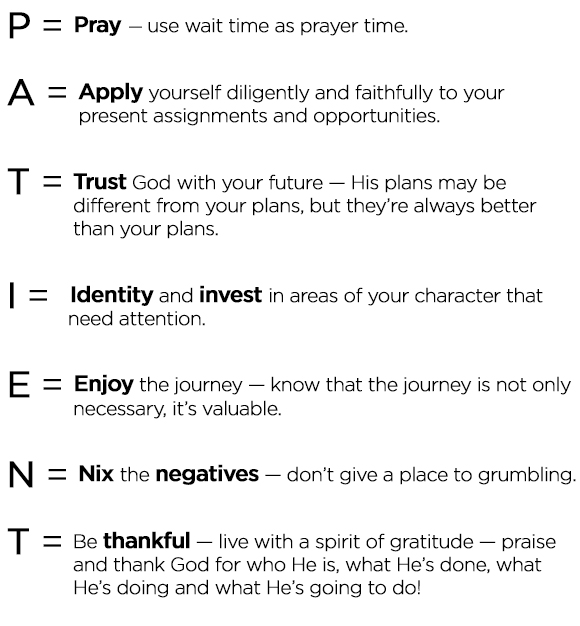
Let’s take a look at how to be a patient “waiter:

What kind of “waiter” are you? Maybe it’s time for some “wait training?

Pastor Dale

What Are You Thinking?

How healthy is your thinking?

After coming to know Jesus as our Savior, we can still miss many of the wonderful things God has for us because of a messed up mind. Our lives can be severely limited by sinful, faulty, misguided, dysfunctional and debilitating thinking.

The quality of your life is determinded by the quality of your decisions, and the quality of your decisions is determed by the quality of your thinking.

The Bible reminds us of this principle:

“Be careful what you think, because your thoughts run your life.” — Proverbs 4:23 (NCV)

There are many examples in the Bible of people who either helped or hurt themselves by their thoughts:

  • The large group of Israelites that wandered in the wilderness for 4 decades, and never made it into the Promised Land. Their doubt-filled, negative thinking cost them 40 years of their lives. It kept them from their God-planned destiny.
  • David’s moral failure with Bathsheba. David’s lustful thinking led him to a horrible lapse in judgment. Although his sin was forgiven by God, the pain and consequences of his failures lingered in his family.
  • Absalom’s bitterness toward his father David. Absalom refused to forgive his father for some of his mistakes. He allowed resentment to fill his heart and mind. Ultimately Absalom’s bitter thinking destroyed him. His life ended prematurely, all because of what he gave place to in his head.
  • Peter’s fearful thinking when Jesus was arrested and prepared for crucifixion. Peter let fearful thinking take over his mind. It caused him to deny Jesus when Jesus needed him most.
  • Judas’ covetous thinking. Judas allowed covetous thinking to cause him to betray Jesus.
  • Paul’s healthy thinking when incarcerated for preaching and teaching about Jesus Christ. Paul’s healthy, joyous thinking while in prison for preaching the Gospel allowed him to write many of the great books of the N.T.
  • John’s healthy thinking when exiled to the island of Patmos for his faith in Jesus Christ. John’s worshipful thinking on the island of Patmos set the stage for a great revelation of Jesus and the activities happening in heaven.

A messed up mind makes a messed up life! A well-managed mind leads to a well-managed life! An undisciplined mind leads to a diminished, dissipated life! A disciplined mind leads to a positive, productive and fruitful life!

What are you thinking?

Success or failure, victory or defeat — first happens in the head! Change your life by changing your thinking!

Pastor Dale

Making The Most of a Holiday

I regularly talk to and pray with people who find holidays challenging. For a variety of reasons, special times of the year can feel more like a burden than blessing to some folks.

While there's usually some positive anticipation associated with the arrival of a holiday, there can also be apprehension. Holidays can put people in situations and in environments that are pregnant with tension and stress. Old wounds can be re-opened and new wounds inflicted when people find themselves in the same room or around the same table with a family member or acquaintance with whom they have some bad history, unresolved issues or continuing strife. The slightest negative comment can spark conflicts or awkward moments. It doesn't take much to turn, what should be a pleasant gathering, into a war zone.

How can you make your holidays more pleasant? How can you bring something of value, health and maturity to your holiday gatherings?

Take a look at something Jesus said:

Blessed are the peacemakers, for they will be called children of God. — Matthew 5:9 (NIV)

Jesus taught that our happiness — our blessings — are linked to our commitment to “peacemaking.” When we make peace with others, we're behaving as a child of God should behave — we're acting in a way that is becoming to someone who is a part of God's family.

How do we do this?

Here are some practical steps you can take that will help you become a “peacemaker,” especially in situations where conflict could easily erupt this holiday season:

  • P = Be positive. Decide that you're going to be a positive person and a positive influence in the atmosphere and interaction. Pray your attitude into a positive place.
  • E = Be an encourager. Speak encouraging words. Generously sow encouraging comments. Go the second mile in being an encourager. Hearts open up when we speak affirming, appreciative and encouraging words.
  • A = Be an active listener. Focus on asking others about themselves. Show sincere interest in the people present. Don't be as concerned with telling your stories, sharing your opinions or pointificating on your ideas as you are in finding out the stories and needs of others.
  • C = Be careful. Carefully consider your conversations. Don't let yourself get trapped into an ugly and old way of interacting. If you know that a certain topic or tone is going to create anger, cause hurt and pain or ignite controversy, don't go there. In short, think before you speak. It's amazing how many problems we avoid when we put our mind in motion before we put our mouth in gear!
  • E = Elevate the environment. To “elevate” is “to raise to a higher level; to lift up; to promote to something greater and better.” Don't “go low” in your interactions. Take the “high road” of grace, patience, forgiveness and maturity in your behavior and spirit. Don't let others bring you down. Choose and lovingly work to lift others up!

Make a decision to make the most of your holidays. Find God's blessings by being a peacemaker!

Pastor Dale


More Blessed

There’s a familiar phrase — a Bible verse that lots of people recognize. It’s a quote from Jesus that gives us a great life principle:

… remembering the words the Lord Jesus himself said: “It is more blessed to give than to receive.” — Acts 20:35 (NIV)

This life principle has been researched and proven to be true. People who regularly and generously give are happier, healthier and less stressed. Sincere givers learn the joy of being a “channel of blessings” rather than simply a “consumer of blessings.” They enjoy the process of passing on resources that help and encourage others. Their pleasure is found in “giving” more than in “getting.”

Giving is one of the keys to a refeshed life. In-flow without out-flow invites stagnation and “disease.” Take a look at a pond that gathers water without releasing it. All kinds of ugly things — seen and unseen — breed there.

When you stop giving to God and others, your life becomes stale and your heart incrementally shrinks. Ugly consequences show up in the souls of people who are stingy, selfish and miserly.

If you want the best life possible, one of the decisions you’ll need to make is to be a giver. You must decide and determine that nothing, absolutely nothing, is going to stop you from giving. At the core of your being you must believe the words of Jesus — “It’s more blessed to give than to receive!

The sad fact is, we live in a world of withholders. Marriages and friendships are damaged by emotional withholders. Churches, ministries and missions often struggle in fulfilling their calling because too few folks contribute time, talents and treasures to their work. Productivity and signifcant advances in organizations and businesses are restricted because people don’t give their best efforts. Parsimony of spirit never leads to anything good. Generosity leads to great places!

Here are 6 great reasons to be generous:

  • It helps us be like God. God is generous. When you’re generous, you’re imitating Him!
  • It frees us from stress and tension. Holding tight to anything brings fatigue. Release brings rest.
  • It attracts blessings. Another word for generous is “magnanimous.” The root word for “magnanimous” is “magnet.” When we give we attract blessings.
  • It demonstrates maturity. Small people live to get. Big (mature) people live to give.
  • It increases opportunities and influence. Greater opportunities come to people who invest of their resources in others. When your heart is generously invested in something, your influence grows.
  • It reveals true faith and trust. When we give we’re saying, “God I trust you to take care of me!

How about you? Are you on the path to a “more blessed” life? If not, get started today!

Pastor Dale

Avoiding “Viruses”

Have you ever been in a confined place with someone who was coughing or sneezing without concern about others around them? This happens frequently in elevators, waiting rooms, lobbies, offices, on airplanes, and in a variety of other environments. What do you feel when this happens? What is your instinctive reaction?

If you're like me, and I suspect you are, you feel uncomfortable. You want to distance yourself from the germs that are being projected into your world. While you may have compassion on the suffering person, you don't want to catch whatever it is that they have. You go into protective mode. You may politely and carefully withdraw a bit from the person. You probably hold your breath for a moment or two. And you likely look forward to removing yourself from the environment as soon as possible. These things are important and wise to do.

Let's apply the same wisdom to another area of life. As surely as physical viruses can be caught from others, bad attitudes can be caught too. The Bible teaches us that bad attitudes are contagious:

Don't hang out with angry people; don't keep company with hotheads. Bad temper is contagious –– don't get infected. — Proverbs 22:24, 25 (Msg)

Do not be deceived: “Bad company corrupts good morals.” — 1 Corinthians 15:33 (NAS)

The next time you're around someone who is “coughing and sneezing” bad attitudes; negativity, gossip, anger, fear, worry, and any other spiritual and emotional virus:

  • Recognize it. Be alert to potential spiritual and emotional germs around you.
  • Respond to it. If you have a relationship with the person, give them some feedback about what you’re seeing or hearing from them.
  • Refuse to receive it. Make a conscious decision that you're not going to be infected by the person.
  • Remove yourself from the situation. Get away from an infected person or environment as soon as you can.
  • Refresh right attitudes after the exposure. After removing yourself, recheck and refresh right attitudes in your heart. Make sure no viral residue remains in you.

Don't let someone else's spiritual and emotinal germs get into your system. Avoid infection!

Pastor Dale

Re-friending

Friends are wonderful. It's great to have people in your life that share some common connection and positive chemistry with you. Being together with a friend is something you look forward to and enjoy. You add to each other's life. Friends are a blessing and a gift.

Sadly, however, sometimes friendships face challenges. Something happens in the relationship and things change. Feelings get hurt, trust is broken, motives are questioned and communication become painful. Walls go up and former friends are estranged, and even worse, become enemies.

Paul, a leader of the early church, gave a lot of attention to relationship issues in his teachings. He frequently reminded Christian believers of the traps and pitfalls of bad feelings and behavior toward one another. Sometimes he got very specific. In some situations he even called out people by name, addressing their disagreements and division.

This was the case when he wrote to the church in a place called Philippi. Two ladies in the church who had been great friends at one time were now at odds with each other. They had an unsettled disagreement. Their disagreement had isolated them from each other and was affecting other people around them.

Take a look at Paul's straightforward instructions, and slight rebuke, to them:

Now I appeal to Euodia and Syntyche. Please, because you belong to the Lord, settle your disagreement. — Philippians 4:2 (NLT)

And now I want to plead with those two dear women, Euodias and Syntyche. Please, please, with the Lord's help, quarrel no more– be friends again. — Philippians 4:2 (The Living Bible)

Paul was deeply concerned about what these ladies had allowed to come between them. If you read further in Philippians 4 you'll discover that these women had once been great friends and had worked together — side-by-side — serving God and the church. Their relationship plummeted for some reason. Over time they moved from cooperating with each other to contending with each other.

We don't know what happened that led to this separation. All we know is that they were former friends who had become foes. They once had been close, but no longer had a relationship.

What was Paul's guidance to them. He told them to “re-friend” each other. This meant that they would have to drop their offenses, whatever they were, and forgive. They had to willingly lay down their “right to be right” about their disagreement, reconcile and move forward together again.

How about you? What friendship has dissolved because of some disagreement? Are you hurt and angry at your former friend? Have you closed your heart to them? Have you shut them out and determined to write them off?

Perhaps it's a time to take a step toward them again. You can do something, even if it's a small thing, that will start healing the hurt and begin rebuilding the trust between you. Be the one to take the first step toward “re-friending!”

Pastor Dale

One Day …

One day I'll …. ” You've said this before haven't you? It's called a “good intention.” A “good intention” is what we say we want to be or do, but aren't ready to commit effort and energy to now. It projects into the future a kind of “miracle moment” when we'll finally get down to business and fulfill some hope, aspiration or goal.

The problem with “one day” thinking is that, more times than not that day never comes. It's often a way we delay doing the work that needs to be done today. It's a way we let ourselves off the hook for taking action now.

One day” thinking is a symptom of a common human problem called procrastination. Procrastination is a self-imposed postponement of difficult choices and steps. We tell ourselves that we'll eventually “get around to” these things, but usually they go on unattended and unaddressed. Saint Bernard of Clairvaux is attributed with the familiar statement, “the road to hell is paved with good intentions.” Procrastination has robbed lots of people of lots of things, including the destiny of their eternal souls.

The best lives are built by proactivity. Regrets are the fruit of procrastination. At the end of your life you'll celebrate the positive actions you've taken, and painfully grieve the “one day's” that never came.

Get busy being positive and productive. Take the steps now to become the person God wants you to be. Get active doing work that matters. Don't put off the truly valuable things in life. Grow, give, serve, love! And most importantly, live wholly and completely for God! Let your “one day” be today!

Pastor Dale